Friday, 13 September 2013

MY CINEMAS


NOTE: This article written by me was first published in The Hindu, July 15, 2012.
Best Five
Motorcycle diaries (2004)
As a medical student and restless soul, Che Guevera, the mythic leftist youth icon traveled all along the South American continent in a rundown motorcycle with his biochemist friend Alberto Granado. The tour along the poverty stricken exploited populace of Latin America changed him forever and gave him the mission of his life. Che mixed whole-heartedly with lepers in the leper colony they served and refused to wear gloves while touching the lepers. In the end Che is a transformed character. This movie directed by Walter Salles has beautiful shots of landscape of South America with lilting music by Gustavo Santaollala. It is a must-see for all college students who have heart full of dreams, altruism and purity. The journey, the experiences can put one into introspection and transformation- such is the power of the movie.

There will be blood (2007)
Rise of a ruthless oil-magnate in California during the oil boom at the late nineteenth century and early twentieth century was documented in this movie. Beautifully enacted by Daniel Day Lewis, infuses life into the ruthlessness and avaricious character of the Daniel Plainview. The man utilizes innocence of a child to buy land and arm twists the local church to his monetary gain. At last he is friendless as he disowns his child and he kills the church priest.

Schindler’s list (1993)
Supposedly Spielberg’s best movie which won several Oscars with career-best performance by Liam Neeson as a benevolent German businessman who saved 1200 Jew’s lives during 2nd world war. Shot in black and white it shows the horror of the Nazis and how Oskar Schindler ( Liam Neeson), a top ranking German businessman gives the Jews jobs in his factories and saves their lives. The scene where a young girl roaming aimlessly with a red rose and the last scene where the Jews presented him with a gold ring touched my heart. World renowned violinist Itzhak Perlman’s solo violin performance written and performed by him brought to life the trauma of gas chamber victims.

Meghe Dhaka Tara (1960)
This is a heart-rending story of an exploited daughter of a refugee family in Bengal. Supriya Chowdhury played the role of Nita, the daughter brilliantly. Everybody of that family rises up with her help forgetting her in the end. In a sanatorium in the end for treatment of TB, she cries from the bottom of the heart ‘Dada ami banchte chai’ ( Brother I want to live) when his brother narrates the story of well being of her family. A Rabindrasangeet ‘Je rat e mor duar guli bhanglo jhor e’ sung by Debabrata Biswas and Gita Ghatak is a brilliant rendition of a song displaying emotions of the central characters in a movie.

Apur Sansar (1959)
A Ray classic, the last part of Apu trilogy which brought Soumitra Chatterjee and Sharmila Tagore into films. A sweet tale of romance of newly weds Apu and Aparna disturbed by sudden death of Aparna (Sharmila). To forget his pains Apu (Soumitra) takes up a job in a coal mine in MP. One of the most memorable scenes in film history is when Apu throws away pages of his autobiographical novel which was supposed to be his dream-work. The floating pages drifting away in wind still bring lumps in my throat. Another poignant scene is at the end when Apu reclaims his son and walks to the new life.

Those five which almost made it

Central do Brasil (1998)
This movie is all about innocence. A disenchanted middle aged single lady, Dora develops a sweet attachment to an innocent 9 year old boy, Josue and goes on a journey of self-discovery to get the boy back to his father he never met. Dora earns by writing letter for illiterates in Rio Di Janeiro’s Central station which she never posts. She meets this boy whose mother accidentally dies in front of the station. She reluctantly takes care of the boy and tries to reunite him with his father who stays away in a small settlement in Brasil. The innocence in the storyline, in the sweet relationship between this lady and the boy tugs your heart-string. In the end she leaves this boy to get back to Rio and both are left alone with memories. This movie by Walter Salles won several awards in Berlin and Golden Globe.

City of God (2002)
City of god is my favorite any day. Reality does not escape from Rocket, the protagonist of City of God. He is a poor slum dog who wants to have a life free from crime and violence inherent in his surroundings. In Rio di Janeiro’s slum ‘City of God’, the natural course of a child’s life will be of drugs, crime and violence. Rocket’s gun-toting friends and siblings do the same thing. But Rocket wants to lead a clean life. Surprisingly, an ordinary camera comes to his rescue and becomes his passport to an honest world. He shoots photographs, not bullets, like gun-carrying friends and one day, his photograph of warring drug-lords of the slum makes front-page of a newspaper of which Rocket is a door-to-door distributor. Images of crimes from that slum are hard to come by; even police are averse to operate in that slum. Rocket knows these criminals from childhood and his proximity to these bad men is a boon. He can take inside images of this slum and those actually make Rocket a high-earning photographer. The escape from poverty through photography seems very much realistic to me. The man is rising above his destiny by hard work; not winning a jackpot through the hands of destiny. He is maintaining a core of honesty though surrounded by drug-dealers, petty snatchers etc. This act of reality attracted me the most. Fernando Mireilles directed this movie and it won 4 nominations in Academy awards though it won none in 2004. Despite that it is considered a world classic.

Nayak (1966)
This is another classic by Ray which portrays trials and tribulations of an amateur theater actor rising to stardom in films. Thought to be far ahead of its time, this movie shows the insecurities of a movie star, a hitherto unexplored theme in Indian films. Ray used the charisma of the matinee idol of Bengali cinema, Uttam Kumar. None other than Uttam Kumar seemed fit enough to portray the emotions of a film actor shown in several dream sequences and flashbacks while he goes to Delhi in a train. The probing questions of a lady journalist attract him towards her.

Fugitive Pieces (2007)
Recently after I saw ‘Fugitive Pieces’ (2007, directed by Jeremy Podeswa based on a eponymous novel by Canadian writer Anne Micheals) in IIT Bombay film club, a movie about Jacob Beer a holocaust survivor trying to coming to terms with his own loss I rediscovered the haunting melody of Beethoven….I realized why they say Beethoven is a timeless classic. Jacob’s sister used to play on piano ‘The Moonlight Sonata’ by Beethoven and Jacob remembers moonlight sonata from his past when they were a happy family of four until the Nazis hounded them in Poland, killed his parents in front of his own eyes and abducted his sister. Jacob survived miraculously with the kind help of a Greek archeologist. But the trauma that incident left behind is difficult to hide. He grows up in Canada, becomes a successful teacher and writer but never away from his past. He is consumed with the obsession of finding holocaust stories and writing them…..his wife Alexi deserts him once she gets to know from his diary how the shameless vitality of her is a distraction for Jacob’s endless pursuit of the past. In these moments and others when Jacob’s sister comes back in his dreams and memories I could identify with Jacob’s sense of loss.
Cairo time (2009)
I liked Cairo Time thoroughly. It is not like Turning 30 which I was suggested and got disappointed. 
Cairo Time essentially captures the love that never happened between two mature individuals 
disparate in their cultural settings. It's slow and long but passionate like smouldering ember. 
So don't see when you are particularly unhappy. But it's like coffee. Once you get into it you c
annot get out. At least I could not....The music, the photography, the moments of subtlety....s
imply touched me. Juliette, a mother of two comes from US to meet his UN official husband in 
Cairo. But her husband is away. In between she is taken care of by Tareq, a handsome Egyptian 
bachelor. Slowly she falls for Tareq over boat cruise on Nile, chess match in local café, a travel
 to the Pyramids and to Alexandria to attend Tareq’s old flame’s daughter’s marriage. 
They almost kiss once and despite that there are no scenes of physical intimacy; but when her 
husband returns after the long wait Juliette understands she has begun to miss Tareq. We get 
that hint by her uncontrollable sob  in her husband’s arm on the way to the Pyramids. A lovely 
ending for a love lost ! A sublime and haunting film on sensuousness embedded in a platonic 
relationship. This movie got an award in Toronto international film festival.


Sunday, 8 September 2013

Some examples of sense of humour of the Bengalis


When you have a haircut on pavement sitting on a brick, it is Italian salon ( It is brick in Bengali). When CMDA ( Calcutta Metropolitan Development Authority) started digging the arterial roads of Cal for Metro Rail , Calcuttans said CMDA stands for C(K)atche Mati Dekhbi Aay….Jyoti means light in bengali…When Jyoti babu was CM, there used to be frequent and long powercuts in Cal. Whenever loadshedding will begin, drowning the whole para into darkness Calcuttans will say “ Jyoti gelen”. Arrival of power would be greeted as “ Oi Jyoti elen”……

There are several funny translations which a Bengali would only make and roll on floor laughing. Some examples

Aesop’s fables – Isabgul
Army Rum – Joaner Arak
Ration card – Khyber Pass
Empty Space – Khalistan

* When Obama became US Prez and Mrs. Clinton became Secretary of State, Bengalis said " Ek dike Bama, r ek dike Obama"......

* When commies left and Mamatai came they said " Bam shashon sesh, bama shashon shuru" or "Bam gelo Bama elo"

* When BJP promised Ram rajya Bengalis said " Bam shashon er por ki Ram shashon ?"

Some writings on bus,truck etc….

Jonmo theke jwolchi--------Burning till birth (written over a fuel tank of a truck)

Dekhbi r jwolbi, luchir moto fulbi------Look at me and burn in jealousy, as a puri swells in hot oil

Rupo dilam sankra ke nupur gore dilo, gari dilam driver ke pagol kore dilo------Gave some silver to a jeweler, he returned me an anklet. Gave my car to a driver, he turned me mad.

Often told in a bus

Pichoner dike egiye jan…..progress towards back….said in a minibus by a conductor requesting the passengers to move towards rear end of the bus, how apt in today’s Bengal !!

** A zoology student in an exhibition was asked the scientific name of an animal as exhibit. Promptly he said it is Janina janina…..(I don’t know…I don’t know)……but he said it with an accent as if he was saying a Latin name….you know scientific names are Latin names…….

The Gem ……..Heard this in a movie….. “Apnake Boka bolle Ardhek Bola Hoy”…….

Parody
Hari he Madhabo ar kotokal ekla shobo ?


Tuesday, 23 July 2013

On the Similar Tune of a Rabindrasangeet and a Nazrulgeeti

Surprisingly a Rabindrasangeet and a Nazrulgeeti has similar tune. Why ? Can anybody let me know ? Are they based on same Raaga of Hindustani classical music ?

Please listen and note the similarity in tune.
Alpo Loia Thaki Tai....a Rabindrasangeet by Subinoy Roy

Shunyo e buke ...a Nazrulgeeti by Dhiren Basu

Monday, 15 July 2013

On telegram's end : link with Beethoven, Ray and the Tagores


Yesterday was the day when telegram service stopped in India. The title of this blog suggests there is a common link between Beethoven’s Fifth symphony, Satyajit Ray’s Pather Panchali and the Tagores. That link is telegram. Kishore Chatterji, the great western classical music connoisseur suggested me once that the opening movement of Beethoven’s Fifth symphony reminds one of dot-dot-dot-dash, the Morse code. I am attaching the youtube video for your perusal.


Then in Satyajit Ray’s Pather Panchali, Apu and Durga run in the field to see a rail train for the first time. Before they reach to see the locomotive they are puzzled by the humming of the telegraph post which was so nicely captured by the master. Readers are requested to see the following to realize what am I talking about. Somehow the video could not be uploaded, hence I copy the link here for your perusal.

http://www.youtube.com/watch?v=d-JWZDALouI

 
Another anecdote is from Ranjan Bandyopadhyay’s article in Robibashoriyo in Ananadabazar Potrika published about a decade ago . Maharshi Debendranath Tagore sent his eldest son Dwijendranath to handle zamindari in Bengal villages. Dwijoo babu got upset by abject poverty of his subjects and thought of helping by money. He sent a telegram to his father “ Send fifty thousand (50,000)”…Understanding his son’s inability to realize ways of the world, Debendranath replied in another telegram “ Come back soon”.

I remember another Bengali movie Dak Diye Jai where the postmaster delivers a telegram declaring a villager’s death. When the family is still mourning another telegram comes wherein it stated that the last telegram be ignored please and the villager is very much alive. This brings joy back to the family.

There will be some more references of telegrams from cinemas of yesteryear. I don’t remember all. Maybe one can be from Postmaster of Ray or Aparajito of Ray. But I don’t recollect these. I wrote about those which I remember quite well about telegrams.

Sunday, 14 July 2013

On appreciating music and Ray


A question nags me. When we listen to music what do we listen to ? Does the quality of recorded music playing instrument has any role in liking music ?

We mostly listen to music on our music players – CD player, DVD player, PCs, radio, TV, mobile phone, MP3 player etc. Every morning in Mumbai suburban railways I see people with earplugs enjoying music. These days except attending some musical soirees we rarely listen to songs sung by individual or music made by instruments firsthand. And over the past century music recording industry has grown enormously. Now there are copious choices for a consumer to buy a music player. People vouch for their high quality and many boast owning brands.

To bolster my point that music appreciation doesn’t require hi-fi music systems I recount some anecdotal evidences from the master – Satyajit Ray. Mr. Ray as you are aware created music for his films. Except his initial few films where Pandit Ravi Shankar and Ustad Vilayat Khan directed music, most of his films had music created by Ray. Songs of Gupi Gayen Bagha Bayen and Hirak Rajar Deshe became evergreen. Whole generations of Bengalis grew up with it and still treasure these. After his death HMV released a two cassette album named “Music of Satyajit Ray”. I possess a rare recording of his Calcutta Radio interview called “Music I Live By” wherein he described his inspirations and creativity. And many also may remember his lifelong love for Western Classical Music.

As revealed by Bijoya Ray, his wife, in “Amader Kotha” – an autobiography, the master never owned any hi-fi music player for a significant portion of his life. In the last leg of his life he purchased a hi-fi instrument. Otherwise he was happily listening to world class music in Chandni-made Ahuja speakers. Chandhi chowk is a place in central Calcutta where you get cheap electronic goods. His friend Chidananda Dasgupta told in an interview to Sananda after Ray’s death that Manik listened to the best of music ( he meant Western Classical - Bach, Mozart, Beethoven, Gregorian chants etc)  in a ramshackle music player whereas today’s nouveau riche  listen to trash in their costly hi-fi players. This revelation struck a chord in me because I always believe music appreciation does not depend on branded music players. If you have an ear for music, anything is music for your ears.

Ray incidentally liked full-throated singing style (he was particularly fond of Kishore Kumar and Anup Ghosal). He disclosed in an interview to Doordarshan Calcutta after Debabrata Biswas’s death that how he liked George da’s full-throated Rabindrasangeets. The master also lamented in the same interview that with the advent of microphones and loadspeakers singers stylize their voice to suppress the full-throated nature a song demands.

Friday, 19 April 2013

On Calcutta

** I regret to say that the following image has been copied by one DEVIKA and posted in Facebook without acknowledging me. This image is a rare one. I got this book from my college library, scanned the image and uploaded it. I have no intention of copyright infringement ; I already mentioned the source and the publisher. However, DEVIKA copied it from my blog and published in FB which garnered many likes; but I was put in the dark about this theft.


In 1975, Raghubir Singh compiled his photographs of Calcutta in an eponymous book published by The Perennial Press, Hong Kong. Its cover was designed by none other than Satyajit Ray. Joseph Lelyveld of The New York Times wrote a long introductory article. The photographs were doubtlessly good but my attention was drawn to particular text on the Bengalis. There are lot of derogatory comments on Calcutta and its natives but there were some comments on Bengali lifestyle which attracted my attention. I quote relevant portions from the book to showcase the Bengalis who love high-brow culture and can talk volumes on it informally (known as ADDA). 


“If you look for extravagance in Bengali sophistication it is easy to find, not so much in its ceaseless verbal display – the kind associated in other climes with literary cocktail parties and academic common rooms – as in a genuine and frequently astonishing enthusiasm for the remote, the incongruous and the arcane. On an early visit to Calcutta I was talking to a high police official about revolutionary terrorism in his district, only to find that the conversation had been mysteriously diverted to the subject of William Makepeace Thackeray who, it turned out, had been born in Calcutta. Which was my favorite Thackeray novel, the policeman wanted to know. When I admitted I had read only “Vanity Fair”, he urged me to get hold of “Henry Esmond”. Where else in the English-speaking world, I still wonder, could you get that advice in a police station?

Then there was the police official who was approached on the behalf of French director Louis Malle who was in Calcutta filming documentary footage for the cycle of films that later appeared as “ Phantom India”. The occasion was a demonstration near the West Bengal legislature that the police were about to disperse with what is known in India as a Lathi – charge. ………M.Malle had expressed a discreet interest in this technique of crowd control and wanted to know if he could record it on film. Ordinarily, Indian police are no less sensitive to this kind of publicity than Mayor Daley’s troops in Chicago but this, after all, was Calcutta. The officer in command said he had followed M. Malle’s career in Cahiers du Cinema and would be honored to have him film his lathi charge.

For Calcutta, it was almost a predictable response. On still another occasion, a group of intellectuals organized a protest demonstration against Andre Malraux, of all people. They had heard that Malraux, then minister of culture in France, had threatened the tenure of Henri Langlois as secretary general of La Cinematheque Francaise in Paris, the world’s largest archive of old movies. Almost as a reflex, these Bengalis hastened to express their solidarity with Jean Luc Goddard, Alain Resnais, Francois Truffaut and all other luminous figures they had read about.”

I got this book from St.Xavier’s College Mumbai library. This book has a history too. It was a gift to the college library by none other than Gerson da Cunha !


Saturday, 2 March 2013

Reminiscing: Dr. Abir Lal Mukherjee


Dr.Abir Lal Mukherjee, the legendary ENT surgeon of Calcutta died recently. This post is about my recollections about this great man. Calcuttans cannot forget that our Kali pujo and diwali became less noisy because he took an initiative along with West Bengal Pollution Control Board and lawmakers to curb noise. That he was a legendary surgeon is well known. But that he was a good writer and elocutionist is known by few. We knew Dr Mukherjee because he was my maternal grandfather’s junior in medical college Calcutta. Because my grandfather knew him well, he performed my tonsillectomy when I was 5 years old. Later on he performed a surgery to treat my sinusitis in 1996 when I was in college. My post is regarding that incident.

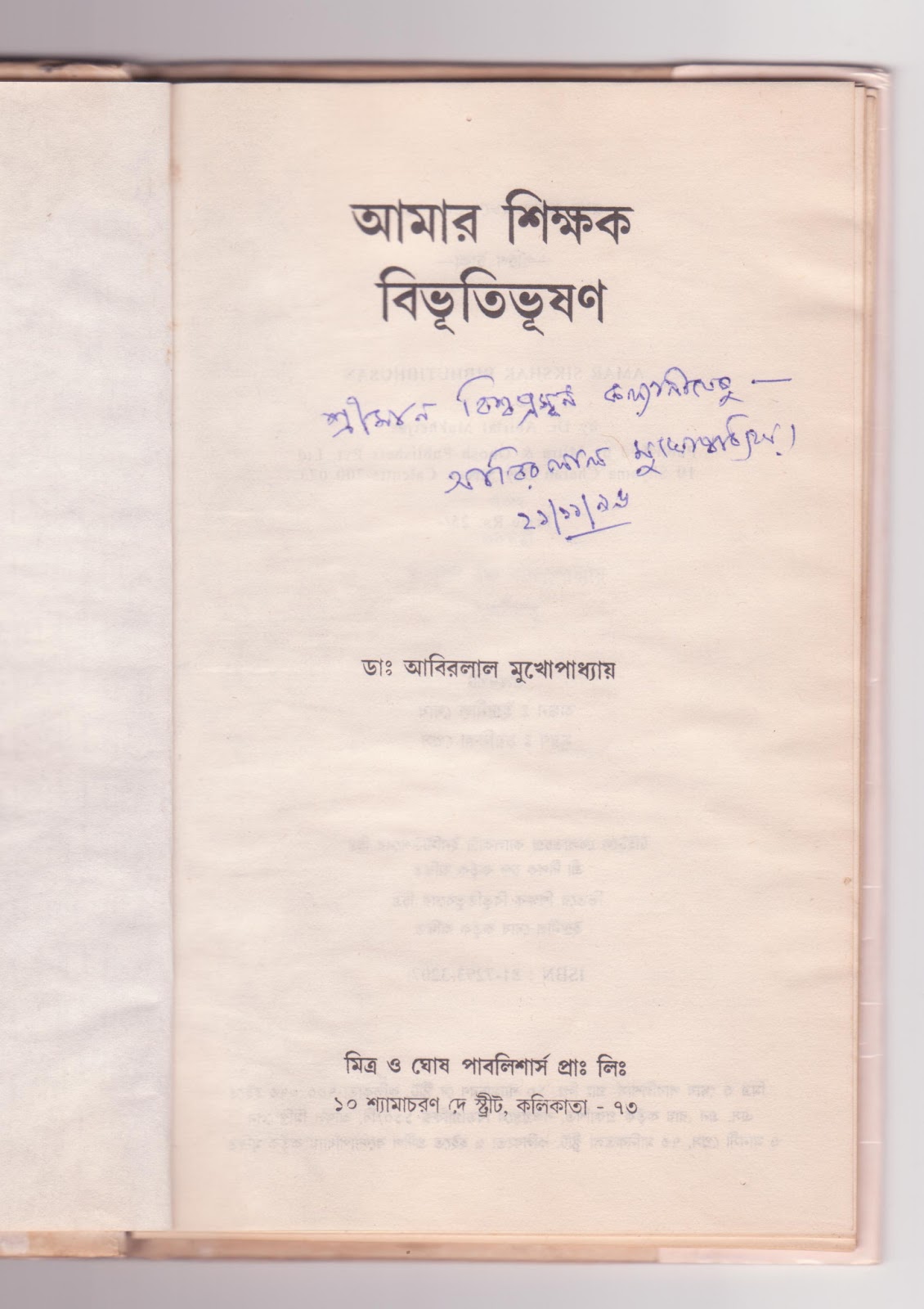
I was admitted in Calcutta Pay Clinic, a nursing home built by my grandfather Dr. Murari Mohan Mukherji and 11 fellow doctors. After the surgery Dr. Abir Lal Mukherjee visited me. After clinical examination I asked him “Were you by any chance a student of noted writer Bibhuti Bhushan Bandyopadhyay? “. He was quizzical. He asked me “How do you know?” Then I told him that Shyamal Gangopadhyay was writing a biographical novel on Bibhuti Bhushan in Sananda and I found his name there. It was written there that Bibhuti Bhushan was a teacher in Khelat Chandra Memorial Institution in North Calcutta and Abir Lal along with his friends accompanied Bibhuti babu to his mess bari in Surja Sen Street (erstwhile Mirjapur Street). Bibhuti babu offered them ‘soan papri’ and asked Abir Lal how he was doing his ‘lathi khela’ despite a small frame. Now listening to this Abir Lal dadu got nostalgic. He sat down, took away his spectacles, cleared them and started going down memory lane. He told me that I was right indeed. He was in class VII when this incident happened. He spoke fondly of Bibhuti babu. He told me how great a teacher he was and how sensitive a man he was. Then he told me that on the day of my release he will present me something. It was a pleasant surprise for me when he presented me a copy of his book named “Amar Shikshak Bibhuti Bhushan” published by Mitra & Ghosh in 1996. In the front page he signed and presented it to me. I was more than glad and it became my proud possession. 
 

Post-release when I visited him he asked me what was the book by Bibhuti babu on his experience of Khelat Chandra Institution? When I told it was Anubartan and I have read it he was so happy. It was not only his affection that elated me but he made one suggestion to my mother I can never forget. He asked my mother on a visit what I wanted to become in life. Please don’t forget I was in 2nd year of B.Sc. (Honours) then. He told my mother “Sadhana, so many of your family have been illustrious teachers! Your grandfather Jogesh babu was a legendary professor in Physics in Rajabazar Science College. Murari da was a legendary surgeon and a professor in plastic surgery. Why don’t you tell your son to follow their footstep? Tell him to teach. He will do well.” I never quite forgot that!

How happy he would have been to see me today as a teacher!

PS: The book on Bibhubhushan by Abir Lal Mukherjee was a great one. It showed his association with Bibhuti babu as a student and then his association with their family after Bibhuti babu’s death. It also had a glimpse of Calcutta of late thirties and early forties. He wrote how Bibhuti babu used to teach them Bangla, Geography, History. It has some rare information on Bibhuti babu’s life – how Bibhuti babu finished his education with the help of his teachers, how he evolved as a writer and how he influenced students. If he scolded students he would go and lament whole evening, such a sensitive soul was he.

Dr. Mukherjee was also a good elocutionist. I remember him reciting Rabindra Nath’s ‘Ebar Firao Mor e’ on ‘Aaj Raat e’ in Calcutta FM flawlessly. I remember one of his splendid article “Shobdo Brahmo na Shobdo Doitya?” about the menaces of noise pollution in Ananda Bazar Patrika in 1996.

RIP Dr. Abir Lal Mukherjee. These days they don’t make them like that anymore.