Saturday, 2 March 2013

Reminiscing: Dr. Abir Lal Mukherjee


Dr.Abir Lal Mukherjee, the legendary ENT surgeon of Calcutta died recently. This post is about my recollections about this great man. Calcuttans cannot forget that our Kali pujo and diwali became less noisy because he took an initiative along with West Bengal Pollution Control Board and lawmakers to curb noise. That he was a legendary surgeon is well known. But that he was a good writer and elocutionist is known by few. We knew Dr Mukherjee because he was my maternal grandfather’s junior in medical college Calcutta. Because my grandfather knew him well, he performed my tonsillectomy when I was 5 years old. Later on he performed a surgery to treat my sinusitis in 1996 when I was in college. My post is regarding that incident.

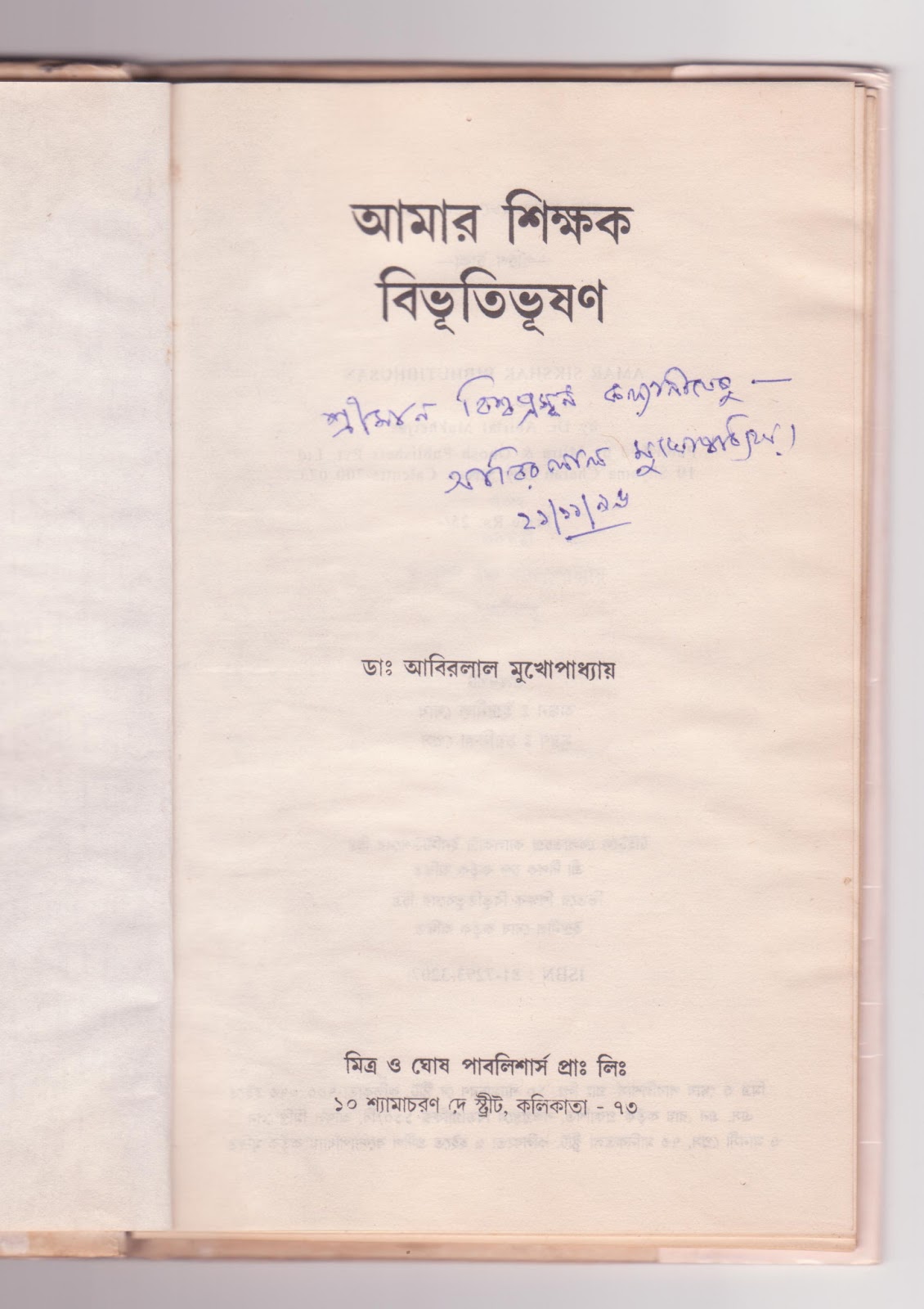
I was admitted in Calcutta Pay Clinic, a nursing home built by my grandfather Dr. Murari Mohan Mukherji and 11 fellow doctors. After the surgery Dr. Abir Lal Mukherjee visited me. After clinical examination I asked him “Were you by any chance a student of noted writer Bibhuti Bhushan Bandyopadhyay? “. He was quizzical. He asked me “How do you know?” Then I told him that Shyamal Gangopadhyay was writing a biographical novel on Bibhuti Bhushan in Sananda and I found his name there. It was written there that Bibhuti Bhushan was a teacher in Khelat Chandra Memorial Institution in North Calcutta and Abir Lal along with his friends accompanied Bibhuti babu to his mess bari in Surja Sen Street (erstwhile Mirjapur Street). Bibhuti babu offered them ‘soan papri’ and asked Abir Lal how he was doing his ‘lathi khela’ despite a small frame. Now listening to this Abir Lal dadu got nostalgic. He sat down, took away his spectacles, cleared them and started going down memory lane. He told me that I was right indeed. He was in class VII when this incident happened. He spoke fondly of Bibhuti babu. He told me how great a teacher he was and how sensitive a man he was. Then he told me that on the day of my release he will present me something. It was a pleasant surprise for me when he presented me a copy of his book named “Amar Shikshak Bibhuti Bhushan” published by Mitra & Ghosh in 1996. In the front page he signed and presented it to me. I was more than glad and it became my proud possession. 
 

Post-release when I visited him he asked me what was the book by Bibhuti babu on his experience of Khelat Chandra Institution? When I told it was Anubartan and I have read it he was so happy. It was not only his affection that elated me but he made one suggestion to my mother I can never forget. He asked my mother on a visit what I wanted to become in life. Please don’t forget I was in 2nd year of B.Sc. (Honours) then. He told my mother “Sadhana, so many of your family have been illustrious teachers! Your grandfather Jogesh babu was a legendary professor in Physics in Rajabazar Science College. Murari da was a legendary surgeon and a professor in plastic surgery. Why don’t you tell your son to follow their footstep? Tell him to teach. He will do well.” I never quite forgot that!

How happy he would have been to see me today as a teacher!

PS: The book on Bibhubhushan by Abir Lal Mukherjee was a great one. It showed his association with Bibhuti babu as a student and then his association with their family after Bibhuti babu’s death. It also had a glimpse of Calcutta of late thirties and early forties. He wrote how Bibhuti babu used to teach them Bangla, Geography, History. It has some rare information on Bibhuti babu’s life – how Bibhuti babu finished his education with the help of his teachers, how he evolved as a writer and how he influenced students. If he scolded students he would go and lament whole evening, such a sensitive soul was he.

Dr. Mukherjee was also a good elocutionist. I remember him reciting Rabindra Nath’s ‘Ebar Firao Mor e’ on ‘Aaj Raat e’ in Calcutta FM flawlessly. I remember one of his splendid article “Shobdo Brahmo na Shobdo Doitya?” about the menaces of noise pollution in Ananda Bazar Patrika in 1996.

RIP Dr. Abir Lal Mukherjee. These days they don’t make them like that anymore.

Wednesday, 27 February 2013

A Tribute to Kishore Chatterji


I would like to pay a tribute to Mr. Kishore Chatterji, a renowned artist, art critic and a proponent of Western Classical Music (WCM) who passed away in 2011.
 
My father Sambhunath Chatterji knew Kishore babu. Kishore Chatterji worked for Tribeni Tissues in HR where my father also worked as a civil engineer. My association with Mr.Chatterji started in 1993 when I started reading his booklet ‘Western Classical Music for Children’ published in a newsletter of Tribeni Tissues, a division of ITC Ltd. I did not harbor any particular liking for WCM at that time. I was busy with my higher secondary studies. Occasional strains of Mozart or Beethoven used to enter my ears as my father used to listen to them while playing cassettes. When I got bedridden for 7 months in 1993 following a bike accident I got hold of his booklet and seriously started listening to WCM. And what pleasure I had! His book not only introduced different forms e.g. concerto, symphony, sonata etc; brief biographies of the composers and anecdotes but also had a must-listen list of concerto, symphony, sonata etc. This got me hooked for life to WCM. I recovered from the injury and joined college. Later on I attended a Western Classical Music appreciation seminar in Max Mueller Bhavan where I heard him giving a talk along with Adi Gazdar, Bulbul Sircar, Prosanto Dutt. I started collecting cassettes and making note of WCM in movies and ad jingles. I believe the power of western classical music had a healing effect because I recovered quite fast. I relayed this view to him in a letter in 1997 to which he sent me a warm reply. He replied to my surprise asking me to visit him. I attach the letter here.


I met him and he took me to my first WCM concert that I attended in Calcutta School of Music. He copied from his collection the music of Beethoven, Mozart, Rossini, Paganini, JC Bach, CPE Bach into at least 12 cassettes for us which I treasure till date. I used to read his columns The Classical Gas and The Strings Attached in The Statesman and sometimes used to answer his quizzes.  I used to cut those pieces and collect in a folder but I lost them since I shifted base so many times. I still miss those articles. I bought one of his Bangla books "Pulu pelo Piano" published by Aajkaal in 2000. I attended many of his programmes on WCM in Max Mueller Bhavan. One notable programme was in 1999 where girls from Shantiniketan sang tagore's songs of death and wherein he presented western composers' idea of death exemplified by music from his vast collection. I attended one of his art show also in Tollygunge Aurobindo Ashram. It was his collage show. I remember his another paiting show on mentally ill persons. He actually visited Institute of Psychiatry in Kolkata and painted their inner thoughts by continuously interacting with them. That was his one of his greatest art works bordering on abstract.


Then I moved to different places on account of my job and academic pursuit and lost touch with him. My father informed me of his demise. I bid him adieu. May his soul rest in peace. He will certainly be missed by Western Classical Music lovers of Calcutta, many of whom, like me, got initiated into this genre of music.

Wednesday, 17 October 2012

Evidence of Cancer diagnosis and treatment in Ayurveda- the ancient Indian medical system


This correspondence refers to the article “Cancer: an old disease, a new disease or something in between?” (1).The article was thought-provoking and eminently readable; however the authors restricted only to ancient Greek and Egyptian medical texts and evidences from fossils and mummies. By this article I want to present the evidences of diagnosis and treatment of cancer from ancient Indian medical system Ayurveda, the recorded history and practice of which dates back to second millennium BC (2). 

Indian clinicians were aware of malignancies and neoplasm. They used to diagnose cancer as swelling of body surface linked to internal organs (tumors or Arbuda) or as non-healing ulcers (Asadhya vrana). The earliest records of malignancies are found in Atharva veda of approximately 2200 BC (3). One of the oldest definitive medical texts from India written in Sanskrit language, Susruta Samhita, dealt with diagnosis and cure of diseases putting focus on surgery. The Susruta Samhita contains 120 chapters divided in 5 books or divisions. Chronology committee of National Institute of Sciences of India considers Nagarjuna’s redaction of Susruta Samhita to be written in 3rd to 4th century AD (2,4) 

Susruta wrote extensively about human anatomy and physiology, pathology, medical and surgical treatment and toxicology. He used to think human beings are composed of three humors- Vayu (air), Pitta (bile), Kapha (phlegm) and blood. Derangement of humors causes disease in his opinion. According to Susruta Samhita Arbuda means fleshy growths and generally non-suppurating tumors which are gradually increasing, painful and deep-seated. He also differentiated Arbuda (tumor) from Granthi (cysts). According to him Granthi is glandular swelling which when broken open gives various discharges. Susruta differentiated Arbuda (tumors) into four types – Raktaja (slightly suppurating malignant tumor), Mamsarbuda (Myoma, malignant tumor of muscle and soft-tissues) or Medaja (Lipoma), Adhyarbuda (metastatic growth) and Dvi-arbuda (a pair of hard, painless contiguous tumors) (3,4). Susruta was also aware of metastasis. He termed metastatic tumor as Adhyarbuda. Because he understood the problem of metastasis and recurrence of tumors he was of the opinion to remove tumors surgically in every possible way from every possible place. He resembled unremoved source of tumor as a small spark of fire which can bring down the whole house (3). Susruta also referred to internal tumors or glandular swellings as Gulma.

Not only diagnosis but treatment of cancers was prescribed in Susruta Samhita. Treatment consisted generally of application of medicated poultices, fomentation with boiled meat, use of emetics and purgatives etc. Para surgical approaches such as maggotification, blood-letting and cauterization by heat and alkali were suggested. Surgical removal of tumors was also prescribed followed by cleansing and bandaging with medicinal preparation containing herbs (3, 4). Susruta provided details of different surgical instruments – at least 20 types of Sastras (sharp instruments) and 101 Yantras (blunt instruments) the graphic details of which can be seen in this reference quoted (2). In fact Susruta samhita shows evidence of complex surgical procedures like rhinoplasty, otoplasty etc which many consider as a foundation for modern day plastic surgery (5, 6).

Traditional medicine in India has a long history and strong presence till date. Innumerable plant species were documented by ancient ayurvedic practitioners and different plant parts have been used for medicinal purpose in different formulations. Since the list is exhaustive few important plants e.g. Haridra (Curcuma longa Linn.), Arjuna (Terminalia arjuna Roxb.), Sallaki (Boswellia serrata Roxb.), Punarnava (Boerhavia diffusa Linn.) etc are mentioned here. In present day, many clinical trials and pre-clinical studies have shown effectivity and mechanism of anticancer activity of ayurvedic herbal medicines for which the reader may see following references (3, 7, 8, and 9). In fact the present day market for traditional medicine in India is significantly large with big and small pharmaceutical players (e.g. Dabur, Arya Vaidya Sala, Himalaya Drug Company etc). According to one estimate in the financial year 1998-1999 the production of traditional medicine in India amounted to US$ 667.5 million (10). To protect the traditional medicines from bio-piracy India is maintaining a Traditional Knowledge Digital Library (TKDL) from 2001 which recently prevented a patent to be granted to an Italian company for anticancer use of natural plant products or essential oils or components from some pistacia species (11). Government of India has promoted traditional medicine actively by setting up institutes to train doctors in traditional medicine and offering research grants to conduct research and clinical trials (10).

Hence from this article it appears that ancient Indian medical scriptures showed proof of cancer diagnosis and treatment over 3-4 millenia ago from now and Indians still practice traditional medicine for general well-being and treatment of maladies as evident from a thriving multi-million dollar industry.

Reference:

1)      David RA & Zimmerman MR. Cancer: an old disease, a new disease or something in between? (2010) Nature Reviews Cancer. vol 10, pp. 728-733

2)      D.M. Bose, S.N.Sen, B.V.Subbarayappa (editors). (2009) A Concise History of Science in INDIA.2nd edition. Chapter 4: Medicine. Universities Press (India) Pvt Ltd, Hyderabad, India.
3)      Lakshmi Chandra Mishra (editor). (2004) Scientific Basis for Ayurvedic Therapies. Chapter 16: Benign growths, cysts and malignant tumors; chapter 14 : Hepatic disorders. CRC Press, Florida, USA.
4)      Priayadaranjan Ray, Hirendranath Gupta, Mira Roy. (1980) Susruta Samhita (A scientific Synopsis). Indian National Science Academy, New Delhi, India.

5)      Loukas M, Lanteri A, Ferrauiola J, Tubbs RS, Maharaja G, Shoja MM, Yadav A, Rao VC. (2010) Anatomy in ancient India: a focus on the Susruta Samhita. J Anat. 217(6):646-50

6)      Raju VK.( 2003) Susruta of ancient India. Indian J Ophthalmol. 51(2):119-22.

7)      Aggarwal BB, Ichikawa H, Garodia P, Weerasinghe P, Sethi G, Bhatt ID, Pandey MK, Shishodia S, Nair MG.(2006) From traditional Ayurvedic medicine to modern medicine: identification of therapeutic targets for suppression of inflammation and cancer. Expert Opin Ther Targets. 10(1):87-118.

8)      Balachandran P, Govindarajan R. (2005) Cancer--an ayurvedic perspective. Pharmacol Res. 51(1):19-30.

9)      Patwardhan B. (2005) Ethnopharmacology and drug discovery. J Ethnopharmacol. 100(1-2):50-2.
10)  http://www.tkdl.res.in/tkdl/langdefault/Common/outcome.asp?GL=Eng, last accessed 17.4.2011.Traditional Knowledge Digital Library. Collaborative Project of Council of Scientific & Industrial Research (CSIR) Department of Ayurveda, Yoga & Naturopathy, Unani, Siddha and Homeopathy (AYUSH), India.
11)  Maarten Bode (2008). Taking Traditional Knowledge to the Market. The Modern Image of the Ayurvedic and Unani Industry, 1980-2000. Orient Longman Pvt Ltd, Hyderabad, India.

Acknowledgement: I thank Mr. Pradeep Kumar Pravakar of IIT Bombay for constantly encouraging me to write this. I also thank Ms. Bhavya Jindal of IIT Bombay for fruitful discussions and help in document search. Thanks are due to IIT Bombay library from where I obtained Ayurvedic textbooks and articles which are quoted herein.

Wednesday, 8 August 2012

How to find a biotech company's secret recipe

I have a story to share. I was a research scholar in Biotechnology in IIT Bombay few years back. I was doing an experiment on cell death by annexin V-Propidium Iodide (PI) assay. I was using a kit supplied by a commercial manufacturer. Incidentally after a series of lab mates used it and when my turn came the crucial buffer of the assay was finished though the annexin V antibody and PI was very much there. My advisor suggested me to not to depend on the manufacturer but to make my own buffer. I was clueless because the supplier did not provide the buffer composition. I searched in internet for a possible composition source. Ultimately a widely used cell biology laboratory protocol book came to my rescue. I found that a simple salt CaCl2 and a HEPES buffer were the key components. I made the buffer according to the instruction laid in the book and voila! utilized that buffer for very many reactions later on.

I learnt this lesson to scour for the buffer composition because my buffer was finished and the company did not provide the ‘secret’ composition. If all company start doing this research will be hampered. Protocols and buffer compositions should be clearly mentioned. In fact earlier version of Maniatis’s Molecular Cloning – a bible for cloning had a nice preface urging the ‘Scientific Illiterates’ to know of the reaction components scientists were using.


Tuesday, 17 July 2012

Western Classical Music


I have forgotten Western Classical Music (WCM). Once it was so dear to me. I used to love, be happy to collect and be happier to learn the nuances….and now! It seems as if it beckons me from my past life…..as if a mist has separated the boat from the shore……Oh! Calcutta……that city gave me so much……For a long time I lost touch. May be for past 7 years….till I left Calcutta for Haldia, then Aurangabad, then Bombay, then Hyderabad. I might have heard occasionally some Dinu Lipatti or Maria Callas or some best of Mozart, Beethoven CD (presented by my friends staying in US)…and some in Youtube (getting irritated when it takes long to buffer while I wait for my Perlman or Horowitz or Oistrakh or Richter……)………and……..and…..that’s all in last 7 years. Nothing more…….

But who but I remember once I used to live and breathe Western Classical Music(WCM), visit concerts in Calcutta School of Music(CSM) and scour the music stores (my favorite was Rhythm in Lindsay street, a friendly avuncular Sardarji owner used to copy CDs into cassette for me those days….God!) in search of cassettes (those days I did not have CD player though I had some CD presented by my friend and presented to my father by his friend……) and Max Mueller Bhavan library…the heaven for Western Classical Music lovers in Cal….so many cassettes I borrowed and copied…so many talks I attended in the music appreciation classes  by my guru Kishore Chatterji ( one on comparison of WCM and Tagore songs on the theme of death….ah ! girls from Santiniketan sung those songs and Mr.Chatterji played his choicest collection…lachrymosa from Mozart, Gluck’s Orpheus and Eurydice…..) and unforgettable talks by Adi Gazdar (he was a doctor, friend of Ray, and played wonderful piano, he played in the class. Helped Jennifer Kapoor in playing piano in Ghare Baire duly acknowledged by Bijoya Ray in ‘Amader Kotha’), Bulbul Sirkar (of Calcutta radio, took memorable interview of Ray on WCM which I have recorded from radio), Proshanto Dutt (conductor of Calcutta School of Music), and then in CSM……pony tailed Neil Mukherji playing Segovia classical guitar (I never knew he played for  Mohiner Ghoraguli, a Bangla band !), my first concert attendance with Mr.Chatterji, then  listening to Robert Vijay Gupta, a 8 year old kid from Julliard, New York playing Vivaldi’s four seasons…I gate crashed into Gyan Manch that day in 1999 ……….I can still hear his pizzicato from Winter……Ah what delight! What a time I had…..and I used to record FM radio talks by Yehudi Menuhin or Gerald Moyer….I left no stones unturned to collect WCM….shops, library, radio…any reference of WCM in movies caught my attention, be it Gregorian chant from Ray’s Shakha Proshakha or Pachelbel Canon from Hollywood movies……and I used to remember WCM tunes from ad jingles and compile cassette out of them from our collection and present it to friends….we had more than 200 cassettes….collection started by my father in 1992……now with dismay I note how time and fungus damage and ruin my beloved collection….my father still lives on the remnant of those…..and I don’t have enough time to collect CDs…..What more disappointment could be that staying in Bombay I missed concerts by Zubin Mehta and Sir Colin Davis and I could only see a single performance by 4 years old National Symphony Orchestra of India ! So much work tied me up.

After so many years of non practice I tend to forget the tunes which I could once recollect instantly…..and which used to give me so much pleasure…I simply wait to regain that exquisite touch of WCM…I simply want to immerse myself into the sea of music which used to make me unbelievably happy….

My association with Kishore Chatterji who single-handedly had been popularizing WCM through his newspaper articles (The Statesman is an institution of Calcutta and only newspaper in the country to carry a weekly authoritative article on WCM by Mr.Chatterji) and his books needs another article. It was because of his book that I started listening to WCM while I was bedridden and recovering from a bike accident …It all started in 1993. My doctors told me I recovered sooner because I was in good mood despite lying on bed for 7 long months…..and what but WCM made me happier those gloomy days! But readers, that’s a different story…..I will write that in a different time. Oh! Calcutta!

Sunday, 6 May 2012

The journal of misfit papers


My article is about how I found two journals who accept papers vetoed by other journals in the field, or results for which there are no takers, or when you question current practices. This sprang from the frustration a scientist feels when his or her paper is summarily overruled, or after thorough peer review and its remedy. When overcoming the dejection of having my first paper being returned by a journal, a colleague kindly counselled me by saying, “Welcome to the real world of science, you have just arrived.” Later on, when I had eventually published my work in another journal, I tried to seek avenues for publishing an unaccepted paper per se. Voila! I found these two unusual journals.
One such journal is ‘Rejecta Mathematica’.(1) It publishes mathematics papers. It has a nice editorial on the rejection-acceptance cycle predominating scientific publications in its inaugural issue. Their requirements are that “submitted research manuscripts must have been previously rejected from a peer-reviewed journal in the mathematical sci­ences,” and that the manuscript must accompany an open letter from the authors stating the full procedure of peer review and final rejection by the previous journal. If you are very disgruntled with your field of research, then they are ready to help you to start a ‘Rejecta’ journal in your field!
Another is the ‘Journal of Negative Results in Biomedicine’.(2) As the name suggests, it publishes articles on clinical trials or pharmaceutical sciences. This journal is published by BioMed Central, an open-access publisher of 220 peer-reviewed journals. The impact factor of this journal is 1.10. The impact factor of a journal indicates how many times an article is cited by readers in a given time. The higher the impact factor of a journal, the better its acceptability. This journal publishes failed clinical trials as well as existing or promising drug molecules which fail to live up to their expectations.
An example of such a paper is on the lack of effect of anti-cholesterol drugs Statins are cholesterol-lowering drugs used to treat patients with cardiovascular diseases.(2) However, this particular article published in this journal of negative results in 2011 showed that continued use of statins in Swedish populations between 1998 and 2002 did not lower any incidence of cardiovascular diseases or mortality rate. It is to be noted that this journal has been FEATURE
publishing such papers for the past ten years.
You may find their approach surprising, amusing or weird, but don’t forget that sometimes, there is no balm more soothing for your bruised ego than a publication to announce your efforts in science.
But the purpose of publishing negative results goes deeper. Sometimes the negative results obtained by the researchers can prevent others from redoing the same experiments or alert others about futility of certain medicines. Any failures of medicines in clinical trials need to be known by the doctors and scientists to avoid future use. Many potential drug molecules in clinical trials show severe side-effects in patients. It is also very frequently seen that pathogens develop resistance to antibiotics, anticancer, anti-parasitic or antifungal drugs. Bacteria resistant to antibiotics after rampant use or cancer cells resistant to anticancer drugs are not unknown. Quite often, transgenic plants carrying pesticide genes grow resistant to the pests over the time.
Journals for publishing negative results in life science or medicine can successfully make the scientific commu­nity aware of these particular failures discussed above, such as side effects, or the development of resistance. Sometimes journals specialising in printing rejected pub­lications can offer a contrarian view of present models to the scientific community, and also alert fellow scientists which way to go or avoid.
Journals which publish rejected papers or negating results about medical or biotechnological use of drugs or proteins can carve a niche in the widely-expanding repertoire of scientific journals.
References:
†. Letter from the editors. (2009) Rejecta Mathematica Vol. 1, No. 1, pp. 1-3
‡. Nilsson S, Mölstad S, Karlberg C, Karlsson JE and Persson LG. (2011) No connection between the level of exposition to statins in the population and the incidence/mortality of acute myocardial infarction: An ecologi­cal study based on Sweden’s municipalities. Journal of Negative Results in BioMedicine , 10:6 (24 May 2011)
1. http://math.rejecta.org/
2. (http://www.jnrbm.com/)

Note: This article written by me appeared first in campus magazine of IIT Bombay in 2011.

Saturday, 17 March 2012

Anandibai Joshi-the first lady doctor of India


Today in any Indian hospital, presence of a lady doctor is not an unusual occurrence. Even the CMO of IIT Bombay hospital is a lady. It is my general perception that in India lady doctors usually takes up softer subjects like gynecology, pediatrics, psychiatry, pathology, biochemistry - subjects where they are expected to be because they are ladies. Their presence is largely absent from super-specialty subjects namely orthopedic surgery, neurosurgery, plastic surgery, cardiology etc. Reasons for ladies not joining these may be several. Working mothers may not be able to do odd hours at emergency; male dominated society may be reluctant to get treated by female doctors. Lack of trust on a woman doctor’s capability is still a major mental block of patients. But even then, the present role of lady doctors in India is undeniable. The Indian lady doctors have come a long way. They started the process of entering medical profession in our country in the 2nd half of nineteenth century which I am going to recount in the following pages. And what a journey it was! Due to initial struggle of few lady doctors in pre-independence era, today we see an emboldened India. This article is a tribute to an undaunted spirit who thought of joining medicine- a typical male bastion.

Let us take a quiz. Who was the first woman doctor in India? Who was the first lady surgeon in India? Dr.Anandibai Joshi became the first lady doctor in 1886 and Dr.Anjali Mukherjee passed M.S. from Calcutta University in 1954. It has to be remembered that introduction of Western medicine in India was not without resistance and took some time to flourish. The prevailing system of Indian medical practice-Ayurveda and Unani could not be overruled. When the British government started medical colleges in 1835 Hindus and Muslims had resistance to the idea of dissection of corpses due to religious reasons and crossing the seas to study medicine in England was regarded as quite sinful. So when Madhusudan Gupta performed dissection in Calcutta Medical College for the first time, the British government saluted him with 21 cannon shots from Fort William, Calcutta.  If it was difficult for Indian men to study allopathic medicine then it was doubly difficult for Indian women to do so.

And Anandibai Joshi holds that honor of being the first woman doctor in India in a time when education for women was unthinkable. Women were not allowed to go outside their home to schools and colleges. They were home-bound and their life revolved around marriage, children and happy domesticity. Purdah system in hindu and muslim households did not allow the girls and ladies of the family to mix with men. Even male doctors were not allowed to treat female patients in many cases. Childbirth was mostly taken care of by untrained midwives. Due to unhygienic practices of these midwives, death of the newborn or the mother was pretty common because of septicemia. In fact, Indian women needed the female doctors badly. But who would be bold enough to go against the male-dominated society to learn medicine?

Anandibai Joshi was one such bold lady. She was born in 1865 in Kalyan in Maharshtra in a staunch Brahmin family. In those days going to school from such a family was equivalent to be outcaste. And following the tradition she was married at the tender age of 9 to Gopalrao Binayak Joshi. Gopalrao was educated, progressive and wanted Anandi to learn English. Gopalrao got a job in Postal department and shifted to Kolhapur. Anandi’s education was going on inside home under the tutelage of her husband. She was extremely lucky to have such a nice husband and without her husband’s active help her medical studies would not have been possible. Being meritorious she learnt Sanskrit, English, Math, History, and Geography in no time. In the meanwhile she gave birth to a baby boy. But the child died due to lack of appropriate medical treatment. Maybe this sad turn of event propelled the couple to make Anandi a doctor. And Gopal left no stones unturned despite his poor income. He kept on writing letters to foreign newspapers to raise funds for Anandi’s medical education. After two years his efforts paid off. A letter to a Christian missionary was published in Christian Review magazine in 1878 which drew the attention of Theodora Carpenter, an American philanthropist. Being a Quaker, Mrs. Carpenter reached out to help her. Anandi went to America in 1883, all alone. Even that was quite a feat at that time for a woman from a Hindu Brahmin family to cross the sinful seas. She started studying medicine in Women’s Medical College of Pennsylvania (now known as Drexel University College of Medicine) and got her M.D. degree in 1886. In front of the bewildered American audience an Indian lady, all of 22 years, received a medical degree from the first all-women medical college of the world. It cannot be forgotten in this context that women doctors were rare in those days even in developed and rich industrialized countries. World’s first woman doctor was Elizabeth Blackwell who passed degree in Medicine in 1849 in USA. And another Elizabeth- Elizabeth Garrett Anderson passed medicine in England. Sophia Jex-blake started London School of Medicine for women in 1874. Lady doctors were laughed off as ‘Physicians in Petticoats’ and reviled in the world famous medical journal The Lancet. So in view of these difficult times, achievement of Anandibai was nonetheless praiseworthy.

All poised to serve the ill, Anandi came back to India in 1886. But the time after she returned proved unfortunate. She became ill and contracted TB due to long sea journey and harsh living condition in US due to poverty. Though she joined Kolhapur hospital to serve them, she took ill and passed away in February, 1887 at an early age of 22. Her wish of serving the nation by treating the ill died untimely and thus unsung was finished, Anandibai Joshi, the first lady doctor of India. It is a pity that she was such short lived and could not blossom into a full-grown doctor. Later-on S.J.Joshi wrote a historical novel called Anandi Gopal on her life which became immensely popular in Maharashtra. A short film and a TV serial  was made on her life too.

The idea of Indian lady doctors did not trickle-off after Anandibai. History says it gained a momentum. Dr.Kadambini Ganguly became the first lady physician from Calcutta Medical College in 1886.  Bidhumukhi Basu was the first lady to be awarded the MB degree from Calcutta Medical College. Allen D’abrew became first MBBS degree holder from Madras Medical College in 1888. As Lady Dufferin Hospital and Lady Hardinge colleges were established in Calcutta and Delhi in the end of nineteenth century and beginning of twentieth century, more and more ladies got enrolled for studying medicine.


Today a significant number of students of medicine in India are girls. Lady doctors are no way behind their male counterparts. In fact, National Family Planning and Child Health programme would have failed without their participation. But today it is a different world. In urban India women are not prevented for studying or making a career. Girls are given equal opportunity as boys. The world in 1870s was a far cry from present day. In a time when women’s education was unthinkable, Anandibai Joshi stood up, took the challenge and fought against all odds to become a doctor. She justifiably took the first step which paved the way for Indian women to study medicine. A lot more change is needed in the outlook of Indian society so that our women doctors can go on in their mission undeterred and rise to greater heights. Time has come that we should put our full trust on our lady doctors so that they do not shy away from cardiac surgery, neurosurgery, and plastic surgery and restrict their career growth.

Reference :
  1. Mohila daktar Bhin groher basinda- a Bengali book on history of Indian women doctors by Chitra Deb. Publisher :- Ananda Publishers,1994.
      ISBN 81-7215-283-3

      2.    Women in Colonial India: Essays on Politics, Medicine, and Historiography
             By Geraldine Hancock Forbes
             Published by Orient Blackswan, 2005
       ISBN 8180280179, 9788180280177
3.   Madhusudan Gupta written by Debashish Bose. Indian J Hist Sci. 1994 Jan-    Mar;29(1):31-40.