Tuesday, 23 July 2013

On the Similar Tune of a Rabindrasangeet and a Nazrulgeeti

Surprisingly a Rabindrasangeet and a Nazrulgeeti has similar tune. Why ? Can anybody let me know ? Are they based on same Raaga of Hindustani classical music ?

Please listen and note the similarity in tune.
Alpo Loia Thaki Tai....a Rabindrasangeet by Subinoy Roy

Shunyo e buke ...a Nazrulgeeti by Dhiren Basu

Monday, 15 July 2013

On telegram's end : link with Beethoven, Ray and the Tagores


Yesterday was the day when telegram service stopped in India. The title of this blog suggests there is a common link between Beethoven’s Fifth symphony, Satyajit Ray’s Pather Panchali and the Tagores. That link is telegram. Kishore Chatterji, the great western classical music connoisseur suggested me once that the opening movement of Beethoven’s Fifth symphony reminds one of dot-dot-dot-dash, the Morse code. I am attaching the youtube video for your perusal.


Then in Satyajit Ray’s Pather Panchali, Apu and Durga run in the field to see a rail train for the first time. Before they reach to see the locomotive they are puzzled by the humming of the telegraph post which was so nicely captured by the master. Readers are requested to see the following to realize what am I talking about. Somehow the video could not be uploaded, hence I copy the link here for your perusal.

http://www.youtube.com/watch?v=d-JWZDALouI

 
Another anecdote is from Ranjan Bandyopadhyay’s article in Robibashoriyo in Ananadabazar Potrika published about a decade ago . Maharshi Debendranath Tagore sent his eldest son Dwijendranath to handle zamindari in Bengal villages. Dwijoo babu got upset by abject poverty of his subjects and thought of helping by money. He sent a telegram to his father “ Send fifty thousand (50,000)”…Understanding his son’s inability to realize ways of the world, Debendranath replied in another telegram “ Come back soon”.

I remember another Bengali movie Dak Diye Jai where the postmaster delivers a telegram declaring a villager’s death. When the family is still mourning another telegram comes wherein it stated that the last telegram be ignored please and the villager is very much alive. This brings joy back to the family.

There will be some more references of telegrams from cinemas of yesteryear. I don’t remember all. Maybe one can be from Postmaster of Ray or Aparajito of Ray. But I don’t recollect these. I wrote about those which I remember quite well about telegrams.

Sunday, 14 July 2013

On appreciating music and Ray


A question nags me. When we listen to music what do we listen to ? Does the quality of recorded music playing instrument has any role in liking music ?

We mostly listen to music on our music players – CD player, DVD player, PCs, radio, TV, mobile phone, MP3 player etc. Every morning in Mumbai suburban railways I see people with earplugs enjoying music. These days except attending some musical soirees we rarely listen to songs sung by individual or music made by instruments firsthand. And over the past century music recording industry has grown enormously. Now there are copious choices for a consumer to buy a music player. People vouch for their high quality and many boast owning brands.

To bolster my point that music appreciation doesn’t require hi-fi music systems I recount some anecdotal evidences from the master – Satyajit Ray. Mr. Ray as you are aware created music for his films. Except his initial few films where Pandit Ravi Shankar and Ustad Vilayat Khan directed music, most of his films had music created by Ray. Songs of Gupi Gayen Bagha Bayen and Hirak Rajar Deshe became evergreen. Whole generations of Bengalis grew up with it and still treasure these. After his death HMV released a two cassette album named “Music of Satyajit Ray”. I possess a rare recording of his Calcutta Radio interview called “Music I Live By” wherein he described his inspirations and creativity. And many also may remember his lifelong love for Western Classical Music.

As revealed by Bijoya Ray, his wife, in “Amader Kotha” – an autobiography, the master never owned any hi-fi music player for a significant portion of his life. In the last leg of his life he purchased a hi-fi instrument. Otherwise he was happily listening to world class music in Chandni-made Ahuja speakers. Chandhi chowk is a place in central Calcutta where you get cheap electronic goods. His friend Chidananda Dasgupta told in an interview to Sananda after Ray’s death that Manik listened to the best of music ( he meant Western Classical - Bach, Mozart, Beethoven, Gregorian chants etc)  in a ramshackle music player whereas today’s nouveau riche  listen to trash in their costly hi-fi players. This revelation struck a chord in me because I always believe music appreciation does not depend on branded music players. If you have an ear for music, anything is music for your ears.

Ray incidentally liked full-throated singing style (he was particularly fond of Kishore Kumar and Anup Ghosal). He disclosed in an interview to Doordarshan Calcutta after Debabrata Biswas’s death that how he liked George da’s full-throated Rabindrasangeets. The master also lamented in the same interview that with the advent of microphones and loadspeakers singers stylize their voice to suppress the full-throated nature a song demands.

Friday, 19 April 2013

On Calcutta

** I regret to say that the following image has been copied by one DEVIKA and posted in Facebook without acknowledging me. This image is a rare one. I got this book from my college library, scanned the image and uploaded it. I have no intention of copyright infringement ; I already mentioned the source and the publisher. However, DEVIKA copied it from my blog and published in FB which garnered many likes; but I was put in the dark about this theft.


In 1975, Raghubir Singh compiled his photographs of Calcutta in an eponymous book published by The Perennial Press, Hong Kong. Its cover was designed by none other than Satyajit Ray. Joseph Lelyveld of The New York Times wrote a long introductory article. The photographs were doubtlessly good but my attention was drawn to particular text on the Bengalis. There are lot of derogatory comments on Calcutta and its natives but there were some comments on Bengali lifestyle which attracted my attention. I quote relevant portions from the book to showcase the Bengalis who love high-brow culture and can talk volumes on it informally (known as ADDA). 


“If you look for extravagance in Bengali sophistication it is easy to find, not so much in its ceaseless verbal display – the kind associated in other climes with literary cocktail parties and academic common rooms – as in a genuine and frequently astonishing enthusiasm for the remote, the incongruous and the arcane. On an early visit to Calcutta I was talking to a high police official about revolutionary terrorism in his district, only to find that the conversation had been mysteriously diverted to the subject of William Makepeace Thackeray who, it turned out, had been born in Calcutta. Which was my favorite Thackeray novel, the policeman wanted to know. When I admitted I had read only “Vanity Fair”, he urged me to get hold of “Henry Esmond”. Where else in the English-speaking world, I still wonder, could you get that advice in a police station?

Then there was the police official who was approached on the behalf of French director Louis Malle who was in Calcutta filming documentary footage for the cycle of films that later appeared as “ Phantom India”. The occasion was a demonstration near the West Bengal legislature that the police were about to disperse with what is known in India as a Lathi – charge. ………M.Malle had expressed a discreet interest in this technique of crowd control and wanted to know if he could record it on film. Ordinarily, Indian police are no less sensitive to this kind of publicity than Mayor Daley’s troops in Chicago but this, after all, was Calcutta. The officer in command said he had followed M. Malle’s career in Cahiers du Cinema and would be honored to have him film his lathi charge.

For Calcutta, it was almost a predictable response. On still another occasion, a group of intellectuals organized a protest demonstration against Andre Malraux, of all people. They had heard that Malraux, then minister of culture in France, had threatened the tenure of Henri Langlois as secretary general of La Cinematheque Francaise in Paris, the world’s largest archive of old movies. Almost as a reflex, these Bengalis hastened to express their solidarity with Jean Luc Goddard, Alain Resnais, Francois Truffaut and all other luminous figures they had read about.”

I got this book from St.Xavier’s College Mumbai library. This book has a history too. It was a gift to the college library by none other than Gerson da Cunha !


Saturday, 2 March 2013

Reminiscing: Dr. Abir Lal Mukherjee


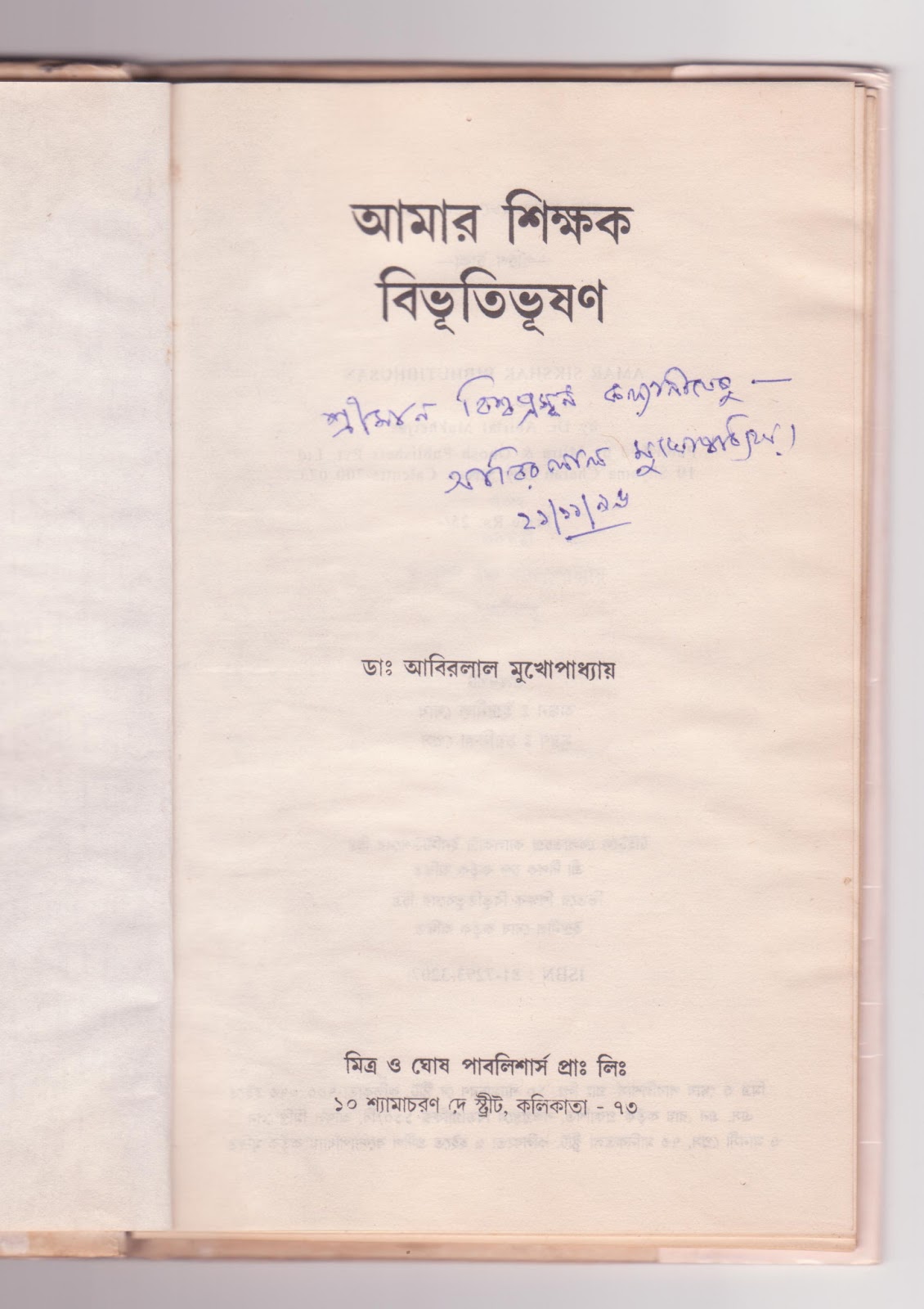
Dr.Abir Lal Mukherjee, the legendary ENT surgeon of Calcutta died recently. This post is about my recollections about this great man. Calcuttans cannot forget that our Kali pujo and diwali became less noisy because he took an initiative along with West Bengal Pollution Control Board and lawmakers to curb noise. That he was a legendary surgeon is well known. But that he was a good writer and elocutionist is known by few. We knew Dr Mukherjee because he was my maternal grandfather’s junior in medical college Calcutta. Because my grandfather knew him well, he performed my tonsillectomy when I was 5 years old. Later on he performed a surgery to treat my sinusitis in 1996 when I was in college. My post is regarding that incident.

I was admitted in Calcutta Pay Clinic, a nursing home built by my grandfather Dr. Murari Mohan Mukherji and 11 fellow doctors. After the surgery Dr. Abir Lal Mukherjee visited me. After clinical examination I asked him “Were you by any chance a student of noted writer Bibhuti Bhushan Bandyopadhyay? “. He was quizzical. He asked me “How do you know?” Then I told him that Shyamal Gangopadhyay was writing a biographical novel on Bibhuti Bhushan in Sananda and I found his name there. It was written there that Bibhuti Bhushan was a teacher in Khelat Chandra Memorial Institution in North Calcutta and Abir Lal along with his friends accompanied Bibhuti babu to his mess bari in Surja Sen Street (erstwhile Mirjapur Street). Bibhuti babu offered them ‘soan papri’ and asked Abir Lal how he was doing his ‘lathi khela’ despite a small frame. Now listening to this Abir Lal dadu got nostalgic. He sat down, took away his spectacles, cleared them and started going down memory lane. He told me that I was right indeed. He was in class VII when this incident happened. He spoke fondly of Bibhuti babu. He told me how great a teacher he was and how sensitive a man he was. Then he told me that on the day of my release he will present me something. It was a pleasant surprise for me when he presented me a copy of his book named “Amar Shikshak Bibhuti Bhushan” published by Mitra & Ghosh in 1996. In the front page he signed and presented it to me. I was more than glad and it became my proud possession. 
 

Post-release when I visited him he asked me what was the book by Bibhuti babu on his experience of Khelat Chandra Institution? When I told it was Anubartan and I have read it he was so happy. It was not only his affection that elated me but he made one suggestion to my mother I can never forget. He asked my mother on a visit what I wanted to become in life. Please don’t forget I was in 2nd year of B.Sc. (Honours) then. He told my mother “Sadhana, so many of your family have been illustrious teachers! Your grandfather Jogesh babu was a legendary professor in Physics in Rajabazar Science College. Murari da was a legendary surgeon and a professor in plastic surgery. Why don’t you tell your son to follow their footstep? Tell him to teach. He will do well.” I never quite forgot that!

How happy he would have been to see me today as a teacher!

PS: The book on Bibhubhushan by Abir Lal Mukherjee was a great one. It showed his association with Bibhuti babu as a student and then his association with their family after Bibhuti babu’s death. It also had a glimpse of Calcutta of late thirties and early forties. He wrote how Bibhuti babu used to teach them Bangla, Geography, History. It has some rare information on Bibhuti babu’s life – how Bibhuti babu finished his education with the help of his teachers, how he evolved as a writer and how he influenced students. If he scolded students he would go and lament whole evening, such a sensitive soul was he.

Dr. Mukherjee was also a good elocutionist. I remember him reciting Rabindra Nath’s ‘Ebar Firao Mor e’ on ‘Aaj Raat e’ in Calcutta FM flawlessly. I remember one of his splendid article “Shobdo Brahmo na Shobdo Doitya?” about the menaces of noise pollution in Ananda Bazar Patrika in 1996.

RIP Dr. Abir Lal Mukherjee. These days they don’t make them like that anymore.

Wednesday, 27 February 2013

A Tribute to Kishore Chatterji


I would like to pay a tribute to Mr. Kishore Chatterji, a renowned artist, art critic and a proponent of Western Classical Music (WCM) who passed away in 2011.
 
My father Sambhunath Chatterji knew Kishore babu. Kishore Chatterji worked for Tribeni Tissues in HR where my father also worked as a civil engineer. My association with Mr.Chatterji started in 1993 when I started reading his booklet ‘Western Classical Music for Children’ published in a newsletter of Tribeni Tissues, a division of ITC Ltd. I did not harbor any particular liking for WCM at that time. I was busy with my higher secondary studies. Occasional strains of Mozart or Beethoven used to enter my ears as my father used to listen to them while playing cassettes. When I got bedridden for 7 months in 1993 following a bike accident I got hold of his booklet and seriously started listening to WCM. And what pleasure I had! His book not only introduced different forms e.g. concerto, symphony, sonata etc; brief biographies of the composers and anecdotes but also had a must-listen list of concerto, symphony, sonata etc. This got me hooked for life to WCM. I recovered from the injury and joined college. Later on I attended a Western Classical Music appreciation seminar in Max Mueller Bhavan where I heard him giving a talk along with Adi Gazdar, Bulbul Sircar, Prosanto Dutt. I started collecting cassettes and making note of WCM in movies and ad jingles. I believe the power of western classical music had a healing effect because I recovered quite fast. I relayed this view to him in a letter in 1997 to which he sent me a warm reply. He replied to my surprise asking me to visit him. I attach the letter here.


I met him and he took me to my first WCM concert that I attended in Calcutta School of Music. He copied from his collection the music of Beethoven, Mozart, Rossini, Paganini, JC Bach, CPE Bach into at least 12 cassettes for us which I treasure till date. I used to read his columns The Classical Gas and The Strings Attached in The Statesman and sometimes used to answer his quizzes.  I used to cut those pieces and collect in a folder but I lost them since I shifted base so many times. I still miss those articles. I bought one of his Bangla books "Pulu pelo Piano" published by Aajkaal in 2000. I attended many of his programmes on WCM in Max Mueller Bhavan. One notable programme was in 1999 where girls from Shantiniketan sang tagore's songs of death and wherein he presented western composers' idea of death exemplified by music from his vast collection. I attended one of his art show also in Tollygunge Aurobindo Ashram. It was his collage show. I remember his another paiting show on mentally ill persons. He actually visited Institute of Psychiatry in Kolkata and painted their inner thoughts by continuously interacting with them. That was his one of his greatest art works bordering on abstract.


Then I moved to different places on account of my job and academic pursuit and lost touch with him. My father informed me of his demise. I bid him adieu. May his soul rest in peace. He will certainly be missed by Western Classical Music lovers of Calcutta, many of whom, like me, got initiated into this genre of music.

Wednesday, 17 October 2012

Evidence of Cancer diagnosis and treatment in Ayurveda- the ancient Indian medical system


This correspondence refers to the article “Cancer: an old disease, a new disease or something in between?” (1).The article was thought-provoking and eminently readable; however the authors restricted only to ancient Greek and Egyptian medical texts and evidences from fossils and mummies. By this article I want to present the evidences of diagnosis and treatment of cancer from ancient Indian medical system Ayurveda, the recorded history and practice of which dates back to second millennium BC (2). 

Indian clinicians were aware of malignancies and neoplasm. They used to diagnose cancer as swelling of body surface linked to internal organs (tumors or Arbuda) or as non-healing ulcers (Asadhya vrana). The earliest records of malignancies are found in Atharva veda of approximately 2200 BC (3). One of the oldest definitive medical texts from India written in Sanskrit language, Susruta Samhita, dealt with diagnosis and cure of diseases putting focus on surgery. The Susruta Samhita contains 120 chapters divided in 5 books or divisions. Chronology committee of National Institute of Sciences of India considers Nagarjuna’s redaction of Susruta Samhita to be written in 3rd to 4th century AD (2,4) 

Susruta wrote extensively about human anatomy and physiology, pathology, medical and surgical treatment and toxicology. He used to think human beings are composed of three humors- Vayu (air), Pitta (bile), Kapha (phlegm) and blood. Derangement of humors causes disease in his opinion. According to Susruta Samhita Arbuda means fleshy growths and generally non-suppurating tumors which are gradually increasing, painful and deep-seated. He also differentiated Arbuda (tumor) from Granthi (cysts). According to him Granthi is glandular swelling which when broken open gives various discharges. Susruta differentiated Arbuda (tumors) into four types – Raktaja (slightly suppurating malignant tumor), Mamsarbuda (Myoma, malignant tumor of muscle and soft-tissues) or Medaja (Lipoma), Adhyarbuda (metastatic growth) and Dvi-arbuda (a pair of hard, painless contiguous tumors) (3,4). Susruta was also aware of metastasis. He termed metastatic tumor as Adhyarbuda. Because he understood the problem of metastasis and recurrence of tumors he was of the opinion to remove tumors surgically in every possible way from every possible place. He resembled unremoved source of tumor as a small spark of fire which can bring down the whole house (3). Susruta also referred to internal tumors or glandular swellings as Gulma.

Not only diagnosis but treatment of cancers was prescribed in Susruta Samhita. Treatment consisted generally of application of medicated poultices, fomentation with boiled meat, use of emetics and purgatives etc. Para surgical approaches such as maggotification, blood-letting and cauterization by heat and alkali were suggested. Surgical removal of tumors was also prescribed followed by cleansing and bandaging with medicinal preparation containing herbs (3, 4). Susruta provided details of different surgical instruments – at least 20 types of Sastras (sharp instruments) and 101 Yantras (blunt instruments) the graphic details of which can be seen in this reference quoted (2). In fact Susruta samhita shows evidence of complex surgical procedures like rhinoplasty, otoplasty etc which many consider as a foundation for modern day plastic surgery (5, 6).

Traditional medicine in India has a long history and strong presence till date. Innumerable plant species were documented by ancient ayurvedic practitioners and different plant parts have been used for medicinal purpose in different formulations. Since the list is exhaustive few important plants e.g. Haridra (Curcuma longa Linn.), Arjuna (Terminalia arjuna Roxb.), Sallaki (Boswellia serrata Roxb.), Punarnava (Boerhavia diffusa Linn.) etc are mentioned here. In present day, many clinical trials and pre-clinical studies have shown effectivity and mechanism of anticancer activity of ayurvedic herbal medicines for which the reader may see following references (3, 7, 8, and 9). In fact the present day market for traditional medicine in India is significantly large with big and small pharmaceutical players (e.g. Dabur, Arya Vaidya Sala, Himalaya Drug Company etc). According to one estimate in the financial year 1998-1999 the production of traditional medicine in India amounted to US$ 667.5 million (10). To protect the traditional medicines from bio-piracy India is maintaining a Traditional Knowledge Digital Library (TKDL) from 2001 which recently prevented a patent to be granted to an Italian company for anticancer use of natural plant products or essential oils or components from some pistacia species (11). Government of India has promoted traditional medicine actively by setting up institutes to train doctors in traditional medicine and offering research grants to conduct research and clinical trials (10).

Hence from this article it appears that ancient Indian medical scriptures showed proof of cancer diagnosis and treatment over 3-4 millenia ago from now and Indians still practice traditional medicine for general well-being and treatment of maladies as evident from a thriving multi-million dollar industry.

Reference:

1)      David RA & Zimmerman MR. Cancer: an old disease, a new disease or something in between? (2010) Nature Reviews Cancer. vol 10, pp. 728-733

2)      D.M. Bose, S.N.Sen, B.V.Subbarayappa (editors). (2009) A Concise History of Science in INDIA.2nd edition. Chapter 4: Medicine. Universities Press (India) Pvt Ltd, Hyderabad, India.
3)      Lakshmi Chandra Mishra (editor). (2004) Scientific Basis for Ayurvedic Therapies. Chapter 16: Benign growths, cysts and malignant tumors; chapter 14 : Hepatic disorders. CRC Press, Florida, USA.
4)      Priayadaranjan Ray, Hirendranath Gupta, Mira Roy. (1980) Susruta Samhita (A scientific Synopsis). Indian National Science Academy, New Delhi, India.

5)      Loukas M, Lanteri A, Ferrauiola J, Tubbs RS, Maharaja G, Shoja MM, Yadav A, Rao VC. (2010) Anatomy in ancient India: a focus on the Susruta Samhita. J Anat. 217(6):646-50

6)      Raju VK.( 2003) Susruta of ancient India. Indian J Ophthalmol. 51(2):119-22.

7)      Aggarwal BB, Ichikawa H, Garodia P, Weerasinghe P, Sethi G, Bhatt ID, Pandey MK, Shishodia S, Nair MG.(2006) From traditional Ayurvedic medicine to modern medicine: identification of therapeutic targets for suppression of inflammation and cancer. Expert Opin Ther Targets. 10(1):87-118.

8)      Balachandran P, Govindarajan R. (2005) Cancer--an ayurvedic perspective. Pharmacol Res. 51(1):19-30.

9)      Patwardhan B. (2005) Ethnopharmacology and drug discovery. J Ethnopharmacol. 100(1-2):50-2.
10)  http://www.tkdl.res.in/tkdl/langdefault/Common/outcome.asp?GL=Eng, last accessed 17.4.2011.Traditional Knowledge Digital Library. Collaborative Project of Council of Scientific & Industrial Research (CSIR) Department of Ayurveda, Yoga & Naturopathy, Unani, Siddha and Homeopathy (AYUSH), India.
11)  Maarten Bode (2008). Taking Traditional Knowledge to the Market. The Modern Image of the Ayurvedic and Unani Industry, 1980-2000. Orient Longman Pvt Ltd, Hyderabad, India.

Acknowledgement: I thank Mr. Pradeep Kumar Pravakar of IIT Bombay for constantly encouraging me to write this. I also thank Ms. Bhavya Jindal of IIT Bombay for fruitful discussions and help in document search. Thanks are due to IIT Bombay library from where I obtained Ayurvedic textbooks and articles which are quoted herein.